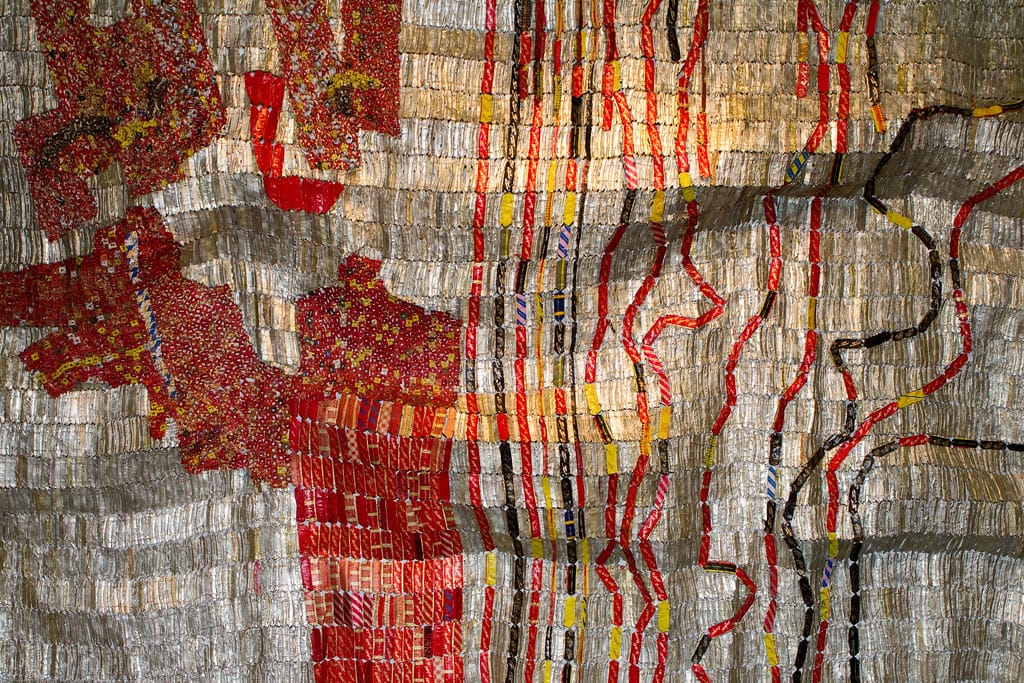
From a distance they look like vast, rippling textiles — gold, red and silver cloths draped across museum walls. Up close, they reveal themselves: thousands of flattened aluminium bottle tops, stitched together with copper wire. The Ghanaian sculptor El Anatsui, who has lived and worked in Nsukka, Nigeria for decades, has spent a career asking what happens when the leftovers of everyday life are given the dignity of art.
Material as memory
The bottle caps come from liquor distilleries, and Anatsui has often spoken about what they carry: histories of trade between Africa and Europe, the drink that once travelled alongside goods and people, and the ordinary rituals of celebration and loss. Folded, crushed and linked by hand, the caps become something closer to kente or adinkra cloth — a reference to West African textile traditions that prize pattern as a kind of language.
Nothing is fixed. Every time a work is hung, it becomes a new work.
Sculpture that refuses to sit still
Crucially, the works are not rigid. Anatsui allows each installation to be folded and hung differently every time it travels, so the piece is never quite the same twice. That openness — the idea that an artwork is a living proposal rather than a finished object — is one reason his influence reaches far beyond the continent.
Recognition has followed: a Golden Lion for lifetime achievement at the Venice Biennale in 2015, and a monumental commission for Tate Modern’s Turbine Hall in 2023. But his most lasting impact may be on the generation of African artists who now treat local materials and histories not as context, but as the centre of global contemporary art.
A market that finally caught up
Anatsui’s rise has coincided with a broader shift. Fairs such as 1-54, founded in 2013 and dedicated to contemporary art from Africa and its diaspora, and institutions like Zeitz MOCAA in Cape Town, opened in 2017, have given the work more visibility. The conversation is no longer about whether African art belongs in the canon — it is about who gets to write the canon next.